A well-maintained wall can make or break a home. Cracks and spalls can develop because of age, water penetration, or movement of the structure. Learning how house painters deal with these problems allows homeowners to keep their homes.
Identifying Wall Damage
The first step house painters take is checking how significant the damage is. There are all different kinds/sizes of cracks (hairline fractures as opposed to larger gaps). Determining the cause is essential because it affects how the repair will be approached.
- Hairline cracks: These usually occur due to paint shrinkage or small settlement.
- Structural Cracks: These are broader and can be a sign of foundation problems.
- Signs of Water Damage: Water stains or peeling of paint can be an indication of leaks or high water content in the air.
When painters inspect these issues, they determine how best repair them to ensure durability.
Preparing the Surface
It is important to prepare well before any repair. This step helps to ensure that repairs bond well and endure for the long-term.
- Preparation: To promote adhesion, dust and debris are removed from the wall.
- Sanding: Rough edges surrounding the crack are made smooth. This creates a uniform surface.
- Eliminating Loose Paint: Any chipping or curling paint is scraped off to avert troubles later on.
Consider these preparatory steps because they set the baseline for successful fixes.
Repairing Cracks and Damage
Different types and extent of wall problems will be addressed by flat, gloss, and sponge rolling house painters through many guiding methods.
Filling Hairline Cracks
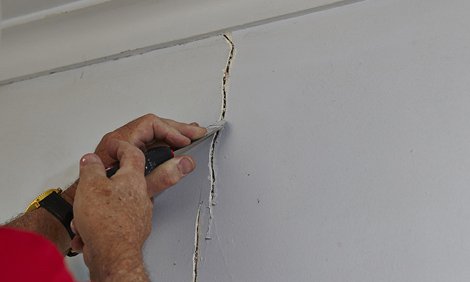
For smaller cracks, painters will use a flexible filler or caulk. This compound adjusts to minor wall movements, stopping future cracking.
- Filler application: Using a putty knife, the filler is applied so that it reaches the bottom of the crack.
- Smoothing: Any excess material is cut away, and the surface is smoothed to match the existing wall.
This is a straightforward procedure that works well for small imperfections.
Addressing Larger Cracks
For larger cracks, more work is required to ensure the stability and longevity.
- Strengthening: A woven tape may be put over the crack for reinforcement.
- Joint Compound Application: It is important to note that this is done in different layers, with the previous layers sanded off between coats to achieve a nice finish.
- Fine Sanding: For a smooth surface.
These are solid fixes for larger problems.
Tackling Water Damage
Following up on water-damaged walls are crucial measure to avoid recurrence.
- Drying the Area: Prior to repairing, the moisture will need to be dried out.
- Stain Blocking Primer: It is a primer that stopswater stains from coming through the paint.
- Waterproof Paint Application: This serves as an extra defense for any moisture issues down the line.
Fixing the underlying cause of the moisture problem is essential for long-term solutions.
Priming and Painting
When the repairs are done, you can prime and paint the wall. This step improves not only the looks but also gives protection.
Choosing the Right Primer
A primer of good quality forms a white base for paint. It also helps to seal the repaired areas, increasing both paint adhesion and durability.
- Stainblocking Primers: Great for covering up places where you repaired water damage or stains.
- Highbuild Primers: Ideal for irregular substrates, these primers offer high filling properties and a smooth surface finish.
The proper primer sets the stage for a perfect result, the right way.
Painting the Wall
Massey house painters know the techniques that get a quality finish with paint.
- Cutting In: Using a brush, paint seams and corners before using a roller to do the rest of the wall.
- Roller: A roller is used on larger areas, providing an even coat.
- Two or More Coats: Most times, two coats are used to create optimal color coverage and depth.
Such consideration leads to a professional and polished finish.
Maintaining Repaired Walls
This can be done routinely after repairs to help maintain the wall’s integrity and its condition over time.
- Spot Cleaning: Dust and dirt are cleaned away to keep surfaces feeling new.
- Watch for New Cracks: Small problems can develop into much bigger ones, and even the tiniest semblance of a crack should not be ignored.
- Humidity Control: Dehumidifiers can keep humidity under control and prevent water damage.
These simple practices aid in maintaining things in the long run.
Conclusion
Filling holes and dressing wall damage is a craft and a science. Professional house painters in Massey, who know how to bring walls back to life. With knowledge of the process and a watchful eye in tow, homeowners can yield effective and aesthetic living spaces for years to come.